
Case Study1word
About Project
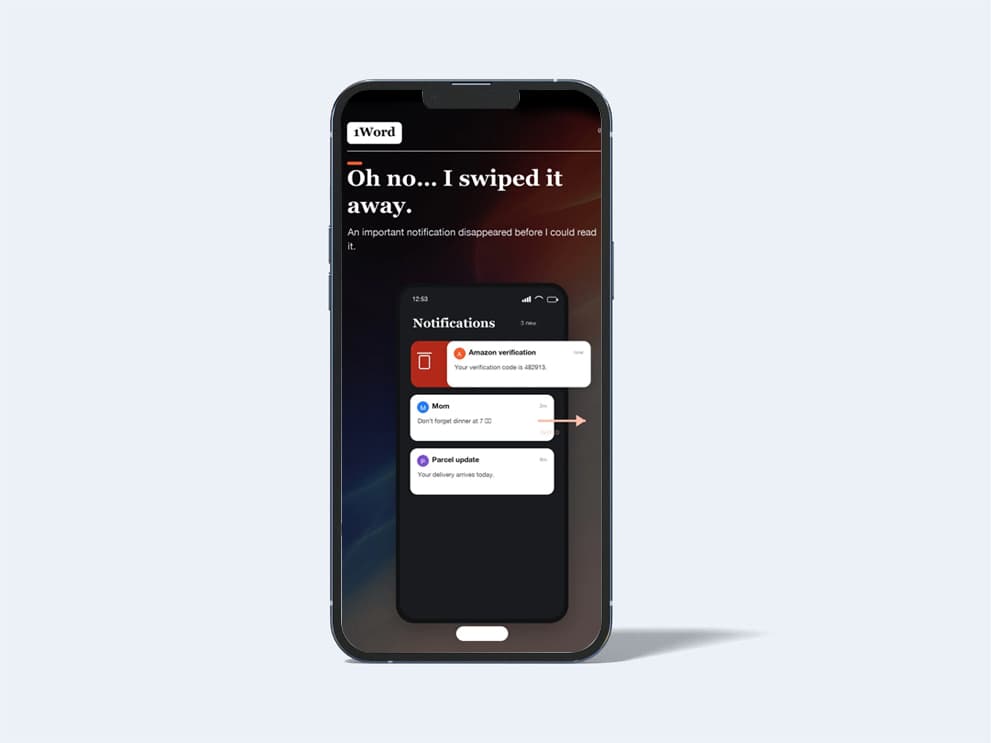
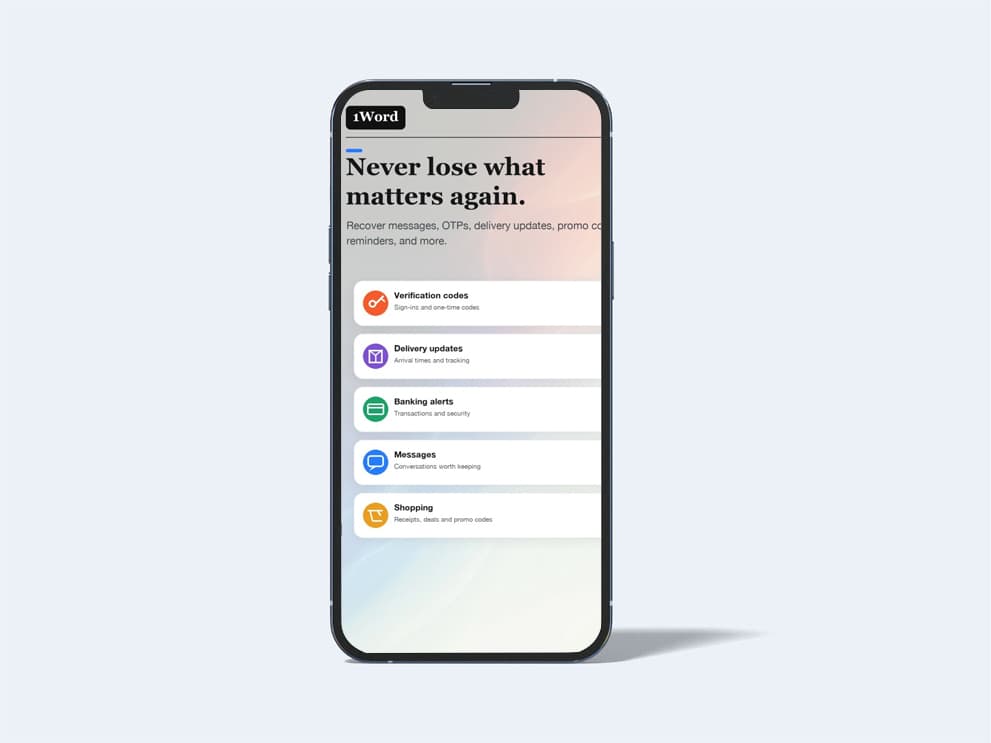
1Word is a smart notification management platform designed to help users keep track of important notifications received across every application on their device. In today's digital environment, users receive a constant stream of notifications — verification codes, personal messages, banking and payment alerts, delivery updates, promotional offers, reminders and work-related information. Important notifications are easily dismissed or buried, making them difficult or impossible to find again later.
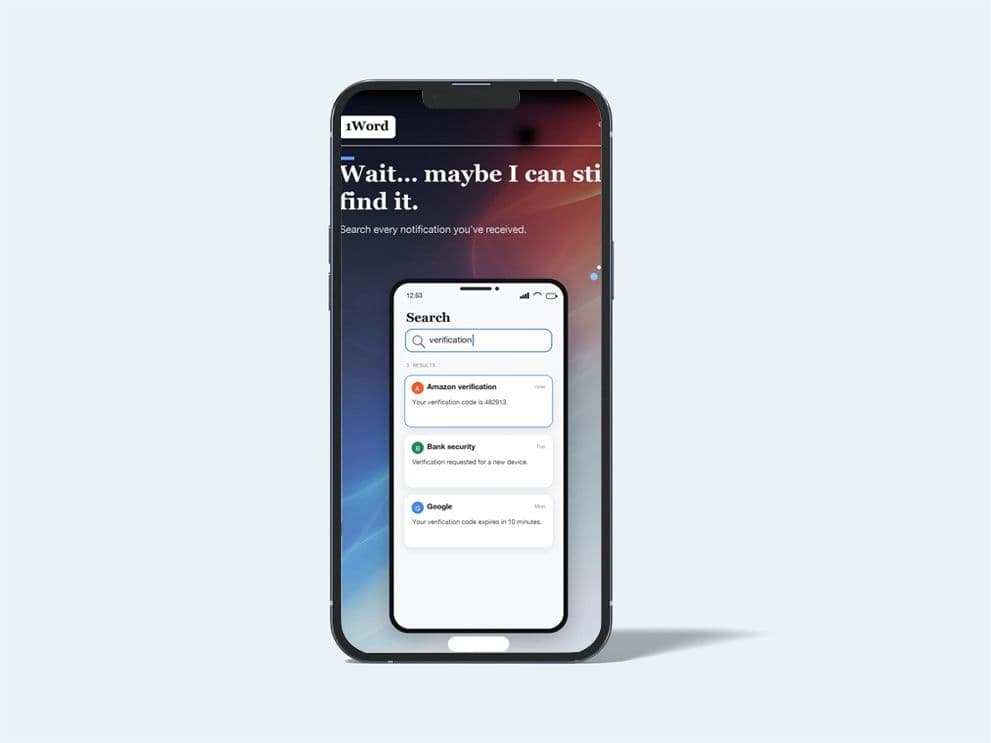
The objective of 1Word was to build a centralized mobile solution that automatically captures and organizes notifications from every app, keeps a permanent searchable history of them, and lets users find what they need again — not only through keywords and app filters, but through everyday, natural-language questions such as "what did my wife tell me to buy last Friday" or "when did Alok last send me a paycheque." The result is a platform that gives users a searchable memory for their phone's notification history, retrievable in the same way they would ask a person to recall it.
Client Requirements
The client required a modern mobile application capable of capturing notifications from every installed app and organizing them into a centralized, permanently searchable history — recoverable even after being dismissed from the device. Key requirements included: Automatic, all-app notification capture running reliably in the background Centralized, persistent notification history stored locally and in the cloud Natural-language search, not just keyword matching — understanding relationships ("my wife"), people's names, and relative dates ("last Friday", "last time") Filtering notifications by application source, sender, tag and category Efficient handling of large and continuously growing volumes of notification records Fast, responsive browsing of notification history Secure user authentication and multi-device account management Secure backend APIs with timezone-aware data handling for a global user base Scalable, cloud-based data storage Subscription-based functionality with in-app billing High-performance, modern mobile user experience The system also needed to be designed with scalability and reliability in mind, so the application could keep capturing and syncing notifications consistently across many different Android devices and manufacturers.
Solutions We Delivered
Ogma Conceptions developed a complete Android, backend, and AI ecosystem for the 1Word platform.
The Android application was built using Kotlin and Jetpack Compose for a modern, responsive and maintainable user interface, with an MVVM architecture, Hilt for dependency injection, and Room for local persistence. Notifications are captured in the background through a dedicated notification-listener service and stored locally the moment they arrive, so nothing is lost even when the device is offline.
To solve background-reliability issues across different Android manufacturers, sync was built on WorkManager for scheduled periodic syncing, backed by an AlarmManager-based fallback that keeps notifications syncing even on devices with aggressive battery-saving restrictions, with automatic recovery after a device restart.
To efficiently handle large volumes of notification records, Paging 3 was implemented for optimized data loading, allowing users to browse a long notification history smoothly without ever loading the complete dataset into memory at once.
The backend infrastructure was developed using Node.js (Fastify) and Python (FastAPI), split by responsibility: the Node.js service handles authentication, notification storage, tagging, payments and account management, while a dedicated Python AI service is solely responsible for turning natural-language questions into precise database queries. This service uses OpenAI for language understanding, NLTK for named-entity recognition to identify people mentioned in a query, and phonetic (Soundex) matching so that nicknames or approximate spellings of a sender's name still resolve correctly. All dates and times are normalized to UTC on the way into storage and converted back to each user's local timezone on the way out, so relative phrases like "last Friday" resolve accurately regardless of where the user is.
MongoDB was used as the primary database, giving the platform flexible, scalable storage for notification records, user data and search results, with Redis caching added on the AI service to keep repeated searches fast and cost-efficient.
The platform architecture follows this workflow:
User Device → Notification Capture → Mobile Application → Backend APIs → AI Search Service → MongoDB → Search & Retrieval
The application enables users to:
- Automatically maintain a complete history of notifications from every app
- Search previous notifications using natural, conversational language
- Locate important verification codes and messages
- Find banking and financial alerts, including the most recent one from a specific sender
- Retrieve promotional offers and discount codes
- Access delivery and tracking updates
- Review reminders and work-related notifications
- Filter and browse notifications by sender, application, tag or category
- The development team focused on performance, background reliability and scalability throughout, to ensure the application stays fast and accurate as a user's notification history grows into the thousands.
Challenges
One of the central challenges was capturing notifications reliably in the background across the wide range of Android devices and manufacturers in real-world use. Several OEM battery-management systems aggressively restrict or delay background work, which put consistent notification sync at risk on certain devices.
A second major challenge was going beyond simple keyword search. Users naturally describe what they're looking for in conversational terms — by relationship ("my wife"), by nickname or approximate spelling ("Alok"), and by relative time ("last Friday", "last time") rather than exact dates or contact names. Turning that kind of everyday language into a precise, accurate database query — correctly, and across every user's timezone — required a purpose-built natural-language processing pipeline rather than standard text search.
Handling a potentially large and constantly growing volume of notification records while keeping the app fast and responsive was another significant challenge. Users can accumulate hundreds or thousands of notifications over time, and loading that history naively would have degraded performance and increased memory consumption.
Finally, the platform needed an architecture that could support smooth, secure synchronization between the Android application and multiple backend services — including a dedicated AI service for search — without compromising the security of sensitive notification content such as banking alerts and verification codes.
Key Features
Centralized Notification Tracking
The application captures and organizes notifications from every installed app, giving users a single, permanent location to access their notification history.
AI-Powered Natural Language Search
Users can ask everyday questions — by sender, relationship, topic or relative date — and the platform resolves them into accurate results, without needing exact keywords or manual scrolling.
Application & Sender-Based Organization
Notifications can be filtered by the application they came from or the person who sent them, including nickname and spelling-variant matching for sender names.
Optimized Data Loading
Paging 3 efficiently loads large notification datasets in the background, keeping the app fast and responsive even with a large history.
Reliable Background Capture
A notification-listener service paired with WorkManager and an AlarmManager fallback ensures notifications are captured and synced consistently, even on devices with restrictive battery-management policies.
Modern Android User Interface
Jetpack Compose was used to build a responsive, modern interface with strong maintainability and a consistent user experience.
Centralized Notification Tracking
The application captures and organizes notifications from every installed app, giving users a single, permanent location to access their notification history.
AI-Powered Natural Language Search
Users can ask everyday questions — by sender, relationship, topic or relative date — and the platform resolves them into accurate results, without needing exact keywords or manual scrolling.
Application & Sender-Based Organization
Notifications can be filtered by the application they came from or the person who sent them, including nickname and spelling-variant matching for sender names.
Optimized Data Loading
Paging 3 efficiently loads large notification datasets in the background, keeping the app fast and responsive even with a large history.
Reliable Background Capture
A notification-listener service paired with WorkManager and an AlarmManager fallback ensures notifications are captured and synced consistently, even on devices with restrictive battery-management policies.
Modern Android User Interface
Jetpack Compose was used to build a responsive, modern interface with strong maintainability and a consistent user experience.
Scalable, Multi-Service Backend
Node.js and Python FastAPI services split responsibilities cleanly between core application logic and AI-driven search, supporting scalable growth.
Timezone-Aware, Secure Data Handling
All notification timestamps are normalized to UTC for storage and converted back to each user's local timezone, with JWT-based authentication securing every request.
Subscription and Account Management
The application supports subscription-based functionality, multi-device account management, and full account deletion. Node.js and Python FastAPI services split responsibilities cleanly between core application logic and AI-driven search, supporting scalable growth.
Timezone-Aware, Secure Data Handling
All notification timestamps are normalized to UTC for storage and converted back to each user's local timezone, with JWT-based authentication securing every request.
Subscription and Account Management
The application supports subscription-based functionality, multi-device account management, and full account deletion.
Project Outcome
1Word was successfully developed as a smart notification management platform that gives users a searchable memory for their notifications — one they can query the same natural way they'd ask a person to recall it.
The platform enables users to retrieve important information that may have been accidentally dismissed or lost from their device notification panel, from verification codes to banking alerts to a message from a family member.
By combining Kotlin, Jetpack Compose and Paging 3 with a scalable Node.js and Python FastAPI backend — and a dedicated AI service for natural-language understanding — the solution delivers a responsive mobile experience while supporting accurate, efficient search over a continuously growing volume of notification data.
The modular, service-based architecture also provides a strong foundation for future feature expansion and continued platform development.
Client

Project Links


Country
 US
US
Technologies we used

FastAPI

Jetpack Compose

Kotlin

MongoDB

Python
Redis
NLTK
Node.js

OpenAI
Paging 3